

If you’re a parent reading this, you’ve probably felt it already:
School alone no longer feels like enough.
College pathways feel uncertain.
Careers are shifting faster than curriculum.
AI is changing what “prepared” even means — and most students are watching it happen from the sidelines.
I’ve spent the last several years working directly with students, families, schools, and educators across the country, and one thing is clear:
The students who are thriving today are not just collecting grades or credentials.
They are building ecosystems around who they are — their skills, interests, projects, and networks — that compound over time.
That belief is what led me to create FutureReadyNow.
⸻
From Traditional Paths to Personal Ecosystems
Earlier in my career, I helped students work with small businesses to gain experience. While that model worked for some, I kept seeing a deeper opportunity:
What if students didn’t have to wait for permission to gain experience?
What if they could build something of their own — guided, structured, and aligned with real-world skills?
What if career exploration didn’t mean guessing, but testing?
FutureReadyNow was built around that question.
Today, we help students design personal ecosystems that prepare them for college, careers, and an AI-driven economy — regardless of what path they ultimately choose.
⸻
What Is an “Ecosystem” for a Student?
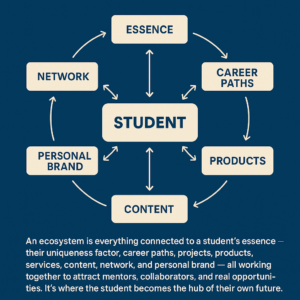
An ecosystem is not a business in the traditional sense.
It’s a cohesive system that brings together:
•a student’s interests and curiosities
•real, future-ready skills (including AI literacy)
•hands-on projects and portfolios
•communication and storytelling
•mentorship, reflection, and direction
At the center of every ecosystem is something we call a student’s Uniqueness Factor.
This is not a résumé line.
It’s the combination of:
1.how a student sees the world
2.what they are naturally drawn to
3.the problems they care about
4.the strengths others already notice in them
5.the kinds of help people instinctively ask them for
When students understand this clearly, everything else — projects, confidence, motivation, direction — becomes easier to build.
⸻
Why This Matters Now (Especially for Parents)
AI is not just changing jobs — it’s changing how value is created.
Students who wait until after graduation to explore, build, or apply their interests are starting at a disadvantage.
The students who stand out in the coming years will be the ones who:
•can articulate what makes them different
•have tested career ideas before committing to them
•understand how to use AI as a tool, not a crutch
•can show evidence of initiative, not just achievement
FutureReadyNow exists to give students a guided, structured way to do exactly that — without burnout, guesswork, or pressure to “have it all figured out.”
⸻
What We Do at FutureReadyNow
Through our programs, students:
•discover and refine their uniqueness factor
•build AI-supported projects aligned with real careers
•create a portfolio they can actually explain and defend
•develop confidence through doing, not just consuming
•learn how to adapt in uncertain environments
We work with families, schools, and coalitions to make sure this work is developmentally appropriate, ethical, and future-focused.
This is not about chasing trends.
It’s about helping students become resilient, capable, and self-directed in a changing world.
What Comes Next
In upcoming entries, I’ll share:
•how students turn their uniqueness into real projects
•how parents can support exploration without pressure
•what “AI readiness” actually looks like (and what it doesn’t)
•how portfolios are replacing traditional signals
•and how students can test futures before committing to them
If you’re a parent wondering how to help your child stand out — not just for college, but for life — you’re in the right place.
The future is not something students should wait for.
It’s something they can start building now.
Swetha Tandri
Founder, FutureReadyNow
|



Responses